
Nano-Sized Thoughts
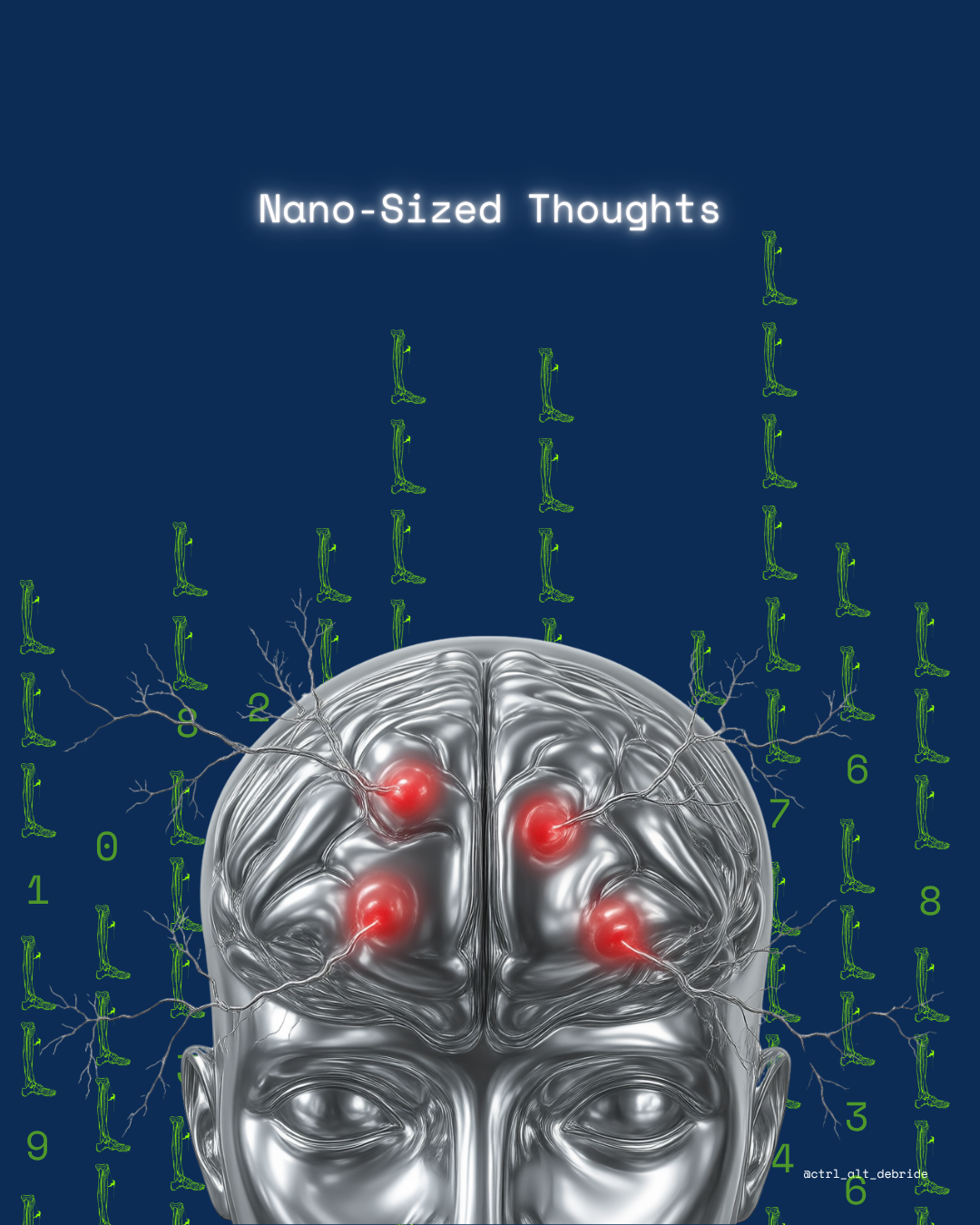
What's a "Nano" and What's it Mean to Wound Care and Nutrition?
There is a word showing up more and more often on product labels, in conference talks, and in the research that crosses a clinician's desk. That word is "nano."
Nanosilver dressings.
Nano-encapsulated vitamins.
Nanoemulsions.
It sounds futuristic, and sometimes it is used more as marketing than as medicine. So it is worth slowing down and asking a plain question: what is a nanoparticle, and why would making something smaller change how well it works? The answer turns out to be less about novelty and more about a quiet bit of physics that has been true all along.
How small is nano-small?
A nanoparticle is generally defined as a material between roughly 1 and 100 nanometers in at least one dimension (Arshad et al., 2021). A nanometer is one billionth of a meter. Numbers that small are nearly impossible to picture, so here are a few comparisons that help bring it into focus.
A sheet of paper is about 100,000 nanometers thick. A single human hair is somewhere between 80,000 and 100,000 nanometers across. A red blood cell is around 7,000 nanometers wide. A strand of DNA is about 2.5 nanometers across. So when a silver particle is engineered down to, say, 20 nanometers, it is smaller than the width of the DNA inside the very bacteria it is meant to act on, and thousands of times thinner than the hair on your arm.
That scale is hard to hold in the mind. The useful takeaway is simpler: at this size, materials stop behaving the way we expect them to in their ordinary bulk form, and they start behaving in new ways.
Why smaller changes the rules
The single most important reason has to do with surface area.
Imagine a sugar cube dropped into a glass of water. It dissolves slowly, because only the outer surface is in contact with the liquid. Now imagine taking that same cube and grinding it into fine powder before adding it. It dissolves almost instantly. The total amount of sugar has not changed at all. What changed is how much of it is exposed.
This is the gist of nanotechnology. When you break a material into nanoscale pieces, you dramatically increase the proportion of its atoms that sit on the surface, where they can interact with the world around them. A nanoparticle has an enormous surface area relative to its tiny volume, which is often described as a high surface-area-to-volume ratio (Arshad et al., 2021). More surface means more contact.
More contact, in many cases, means more activity from the same amount of material. That principle underlies almost every application of "nano" worth paying attention to.
The same lesson, seen in silver
Silver has been used to fight infection for thousands of years, from silver vessels that kept water fresh in antiquity to the silver leaf placed on wounds during the First World War (Rybka et al., 2023). Its antimicrobial activity comes largely from silver in its biologically active form, the silver cation, which damages bacterial cell membranes, disrupts their DNA and enzymes, and generates reactive oxygen species that the microbe cannot survive (Rybka et al., 2023; Lin et al., 2021).
Here is where particle size re-enters the story. The antimicrobial strength of silver is closely tied to the binding surface available to interact with bacteria, which means smaller particles, with their larger relative surface area, can exhibit greater antimicrobial activity than the same mass of silver in a coarser form (Rybka et al., 2023). Nanotechnology lets manufacturers produce silver particles with a very large surface-area-to-volume ratio, and that property is described as imparting greater antimicrobial efficacy while, importantly, lowering toxicity to human tissue (Suhas and Manvi, 2018).
That last point deserves emphasis, because it captures the whole idea. Silver is effective, but at higher concentrations it can be cytotoxic, harming the very fibroblasts and keratinocytes that a wound needs in order to close. Toxicity tends to rise with the form and dose of silver delivered (Rybka et al., 2023). So the engineering goal is not simply "more silver." It is to deliver enough active silver to defeat the pathogen while keeping the total silver load, and therefore the risk to healthy tissue, as low as possible.
Nano makes that trade-off easier to win. Because nanoscale silver puts so much active surface in contact with microbes, a smaller quantity can do the same antimicrobial work.
What that looks like in practice
The wound care literature shows this play out repeatedly. In one comparative study of chronic wounds, nano silver dressings were found to be safe and effective, to promote epithelialization, and to require fewer dressing changes than conventional dressings, with patients in the nano silver group spending less time in the hospital and showing greater reductions in ulcer size (Suhas and Manvi, 2018).
In diabetic foot care, where infection control is a constant battle, reviews describe nano silver dressings as offering a stronger bactericidal effect and a larger contact surface than ordinary silver dressings, allowing better infection control with the added benefit of being difficult for bacteria to develop resistance against (Lin et al., 2021).
A particularly clear illustration of the "less material, same or better result" principle comes from a field comparison of an amorphous nanosilver hydrogel. After eight consecutive days of treatment, 96% of patients showed no remaining clinical symptoms of infection, and the dressing achieved this while carrying one of the lowest silver concentrations on the market, roughly 1 part per million, compared with concentrations ranging from about 30 to 10,000 parts per million in other silver dressings.
The engineering of the particle, not the volume of silver, is doing the work. That is the surface-area lesson translated directly into a patient outcome: more antimicrobial effect, with far less silver resting against the skin.
The principle travels beyond silver
What makes this worth a clinician's attention is that the same physics shows up in a completely different corner of patient care: nutrition.
Many of the nutrients the body needs are poorly absorbed when taken by mouth. Some are unstable, some are barely soluble in water, and some are bound up in forms the gut cannot easily release (Richards et al., 2025). Vitamins A, D, and E, certain carotenoids, omega-3 fatty acids, and many minerals all lose a meaningful fraction of their potential value somewhere between the spoon and the bloodstream (Arshad et al., 2021).
Here again, going small helps. Encapsulating a nutrient in nanoscale carriers, or reducing it to nanoscale particle size, can protect it from being degraded in the stomach and improve how much of it is ultimately absorbed (Arshad et al., 2021). The reasons echo the silver story. Smaller particles dissolve and disperse more readily, and the same surface-area advantage that makes nanosilver more reactive against bacteria makes a nano-formulated nutrient more available to the gut. In one example, preparing iron as solid lipid nanoparticles enhanced its bioavailability more than fourfold compared with commercial tablets (Arshad et al., 2021).
The broader bioavailability literature frames encapsulation and compounding as established tools for closing nutritional gaps, precisely because reducing particle size below a micron and protecting the nutrient from oxidation can enhance absorption several times over (Richards et al., 2025). The mechanism is the same one we started with. Expose more of the material, and you can do more with less of it.
A note of caution alongside the promise
None of this means smaller is automatically better. The same reactivity that makes nanoparticles useful also raises legitimate questions in nutrition. Reviews of nanoparticle delivery consistently flag that toxicity remains a real concern, that the long-term behavior of these materials in the human body is still being studied, and that high-quality human clinical data is still catching up to the laboratory findings (Arshad et al., 2021; Magne et al., 2023). Orally administered silver nanoparticles, for instance, have been observed to alter the gut microflora, which is one reason silver's strongest evidence sits in topical wound care rather than systemic use (Rybka et al., 2023).
The honest summary is that nanotechnology is a tool, not a guarantee. Used thoughtfully, it lets a product accomplish more while exposing the patient to less, whether that is less silver against fragile new tissue or less of a nutrient lost to poor absorption. That is a genuinely useful idea, and it rests on something as simple as a sugar cube dissolving faster when you grind it first.
For providers, the practical question is not whether "nano" sounds advanced. It is whether a given product uses the principle to deliver a real efficiency: the same therapeutic effect, achieved with a smaller and safer dose. When it does, the smallest particles can solve some surprisingly large problems.
References
Arshad, R., Gulshad, L., Haq, I.-U., Farooq, M. A., Al-Farga, A., Siddique, R., Manzoor, M. F., & Karrar, E. (2021). Nanotechnology: A novel tool to enhance the bioavailability of micronutrients. Food Science & Nutrition, 9(6), 3354–3361.
Lin, H., BoLatai, A., & Wu, N. (2021). Application progress of nano silver dressing in the treatment of diabetic foot. Diabetes, Metabolic Syndrome and Obesity: Targets and Therapy, 14, 4145–4154.
Magne, T. M., Alencar, L. M. R., Carneiro, S. V., Fechine, L. M. U. D., Fechine, P. B. A., Souza, P. F. N., Portilho, F. L., Barros, A. O. S., Johari, S. A., Ricci-Junior, E., & Santos-Oliveira, R. (2023). Nano-nutraceuticals for health: Principles and applications. Revista Brasileira de Farmacognosia, 33, 73–88.
Richards, J. D., Cori, H., Rahn, M., Finn, K., Bárcena, J., Kanellopoulos, A. K., Péter, S., & Spooren, A. (2025). Micronutrient bioavailability: Concepts, influencing factors, and strategies for improvement. Frontiers in Nutrition, 12, 1646750.
Rybka, M., Mazurek, Ł., & Konop, M. (2023). Beneficial effect of wound dressings containing silver and silver nanoparticles in wound healing: From experimental studies to clinical practice. Life, 13(1), 69.
Suhas, K., & Manvi, P. N. (2018). Efficacy of nano silver dressings over conventional dressings in chronic wounds. International Surgery Journal, 5(12), 3995–3999.
Thank you for reading!
AÍDA Medical Consultants is an independent supplier of medical products and services to healthcare providers in the US and MENA.